Day 1 and my body is sore, sore, sore!
The beginning went well. The clinic has expanded, and the basement now holds a good sized waiting room with two changing rooms, a washroom and the physiotherapists' kitchen and venting (no doubt) space. All the women I knew have left and been replaced, and one fellow also, with only two familiar guys remaining. Paperwork, payment, then measurements.
New stuff there too. A brand new machine for measuring my back's topography as well as various other measurements that I sort of understand, but not really. Coronal imbalance? Surface rotation? Frontal projection? Pelvic Obliquity? Blue dots, green and purple squiggles, yellow lines. The numbers did not seem to connect with the numbers taken with the previous system, so I was unable to compare then to now. I got basic explanations, but I've forgotten them already. I think I might have to have a conversation with Mr. Google when I get home.
But the main thing is that things did not really get worse, even after a year and a half of mixed adherence to my exercise program! There was only one measurement of minor concern, my hip was shifted more to the right than it should be. Pretty good considering. I was also praised for my general physical condition, especially for my core strength (thank you pilates!), although my lung functions were noticeably less than stellar. I was fighting a bit of a cough, so I was not terribly surprised. Every time I blew hard into the tube, I would get so much air out and then fall into a coughing fit.
But all things considered, it was good news.
I was sent up to join the class for awhile, which was in its 2nd of 4 weeks, and was almost entirely made up of teens. There were 4 adults in a class of 12, including me. It seems that this is not uncommon in December, with holidays approaching and so less time taken off school for the little darlings. We talked about an exercise they had just learned, the weird one with all the props, and thankfully one I hadn't had on my menu plan. I was reminded all over again about how to set up and then got into it, following along at everyone else's speed.
Then it got hard. I was given a list of specific exercises and stretches, and pushed along to work through them as the others were still learning most of them. Every once in a while, I was given an extra element to add, to make it more challenging. I did extra sets. And the hours ticked along.
After lunch I had my one on one time with the head guy, who is very good, but not at all lenient to a woman of a certain age such as me. In between exercises he would do some deep tissue massage.
If you hit on the word "massage" and thought I was having a lovely time there relaxing, you hit on the wrong word. "deep" is more what is was like and "tissue" was what I needed to wipe the tears of pain away. I kid you not! I have a pretty high pain threshold too, but my goodness, some of those muscles were just screaming with anger. Obviously they were way more tight than I thought they were, and sometimes it was so much I would bark out a laugh and shift out of the way to get some relief from the ridiculousness of it.
The one week boot camp is an hour longer each day than the usual course, so I had 8 solid hours a day, with an hour for lunch in between. By the end of the day I was sore and it felt like all the bones had been removed from my body. I trudged off to my friend's house, who was kindly letting me stay, and we polished off a bottle of rioja while describing our daylight hours. That helped, but a deep, hot bath, a firm bed and two ibuprophen would help even more.
Monday, December 7, 2015

Back in the Saddle Again
After 18 months of interruptions to my prescribed back exercise plan, it is time to reboot.
To recap: February 2014 I fell down my stairs. Result: bursitis on my left hip and several months off from any exercise requiring a lot of hip action.
November 2014 I lifted something badly and hurt my right rotator cuff. Result: no overhead lifting of my right arm and very little loading on that shoulder.
May 2015 I was powerwalking and hit uneven pavement. I was walking so fast I couldn't stop myself from hitting the ground, but my right arm valiantly took the blow. Result: ridiculously stubborn arm sprain that only recently allowed me to grip, move and load the arm.
Okay now, stop your smirking!
For those of you who do not know me, I must stress how unlike me it is to have such injuries - to fall or pull or lift wrong or hit anything.
And for those who do know me, well, you have even less reason to smirk as you know this is not representative of my physical movement through the world.
I don't know why these things all happened with such quick succession. Could it be my scoliosis is impacting my balance even more than usual? Or is my mind so preoccupied with brilliance that I am less aware of the pitfalls in my paths? Or am I at an age now when I just don't bounce back like I may have done before? Whatever the reason or reasons, I am suitably chastened and must constantly remind myself to keep mindful of my mind/body correlation. When I go down the stairs I must focus on the fact that I am going down stairs. When I walk over a slippery or bumpy surface I must pay attention to the undulations and conditions beneath my feet. When I lift or carry anything I must use my body correctly. Sounds obvious, but which of us do any of these in a hurry, or while talking to someone else or checking a text? I rest my case.
So, now I am well and strong and must get back into the routine of back exercises that has been so haphazardly kept. You can imagine how pleased I was to find that the Scoliosis SOS clinic in London now provides 1 week refreshers (reboot camp I think of it as!) instead of just the 3 hour assessments to those of us who have completed the full 4 week course. So I postponed my trip until I could afford the week there, and have now arrived in London in the lovely season of wet and mud, that is to say, early December.
Actually I am incredibly curious to know just what my initial scan will reveal. Even though I have not followed my back exercise routine a lot, I have been very active. I take pilates classes twice a week. Yoga once a week. Swimming once a week. Swing dancing once a week. Walking an hour or so three times a week and very often another walk of 2 or more hours. Gardening. Stretching. And physio exercises for my hip and my arm and my shoulder several times a week. No sluffing off here! So would my curvature be the same as it was 18 months ago? Or would it be worse? I can't imagine it would be better. But I have lost a little extra weight now that I am slowly coming off the nerve pain medication (which added weight), so who knows? If nothing else it might be a good indication of just how valuable these scoliosis-specific exercises are after all, and whether improvement is even to be hoped for.
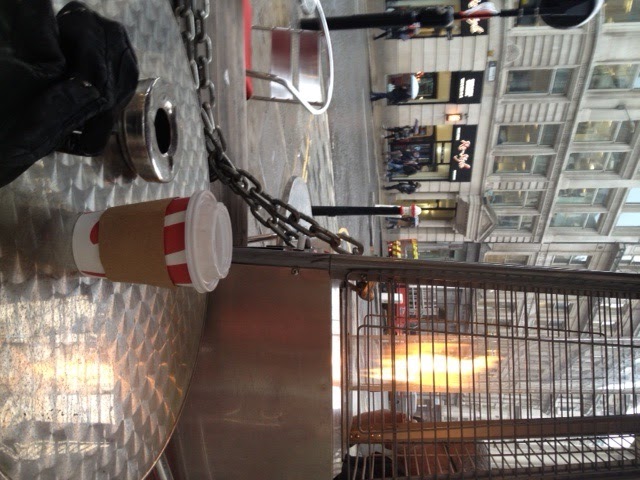
So, I am back in London, drinking a quick coffee at one of the little places I used to go to when I did the clinic in May, 2013. Que sera, sera!

To recap: February 2014 I fell down my stairs. Result: bursitis on my left hip and several months off from any exercise requiring a lot of hip action.
November 2014 I lifted something badly and hurt my right rotator cuff. Result: no overhead lifting of my right arm and very little loading on that shoulder.
May 2015 I was powerwalking and hit uneven pavement. I was walking so fast I couldn't stop myself from hitting the ground, but my right arm valiantly took the blow. Result: ridiculously stubborn arm sprain that only recently allowed me to grip, move and load the arm.
Okay now, stop your smirking!
For those of you who do not know me, I must stress how unlike me it is to have such injuries - to fall or pull or lift wrong or hit anything.
And for those who do know me, well, you have even less reason to smirk as you know this is not representative of my physical movement through the world.
I don't know why these things all happened with such quick succession. Could it be my scoliosis is impacting my balance even more than usual? Or is my mind so preoccupied with brilliance that I am less aware of the pitfalls in my paths? Or am I at an age now when I just don't bounce back like I may have done before? Whatever the reason or reasons, I am suitably chastened and must constantly remind myself to keep mindful of my mind/body correlation. When I go down the stairs I must focus on the fact that I am going down stairs. When I walk over a slippery or bumpy surface I must pay attention to the undulations and conditions beneath my feet. When I lift or carry anything I must use my body correctly. Sounds obvious, but which of us do any of these in a hurry, or while talking to someone else or checking a text? I rest my case.
So, now I am well and strong and must get back into the routine of back exercises that has been so haphazardly kept. You can imagine how pleased I was to find that the Scoliosis SOS clinic in London now provides 1 week refreshers (reboot camp I think of it as!) instead of just the 3 hour assessments to those of us who have completed the full 4 week course. So I postponed my trip until I could afford the week there, and have now arrived in London in the lovely season of wet and mud, that is to say, early December.
Actually I am incredibly curious to know just what my initial scan will reveal. Even though I have not followed my back exercise routine a lot, I have been very active. I take pilates classes twice a week. Yoga once a week. Swimming once a week. Swing dancing once a week. Walking an hour or so three times a week and very often another walk of 2 or more hours. Gardening. Stretching. And physio exercises for my hip and my arm and my shoulder several times a week. No sluffing off here! So would my curvature be the same as it was 18 months ago? Or would it be worse? I can't imagine it would be better. But I have lost a little extra weight now that I am slowly coming off the nerve pain medication (which added weight), so who knows? If nothing else it might be a good indication of just how valuable these scoliosis-specific exercises are after all, and whether improvement is even to be hoped for.
So, I am back in London, drinking a quick coffee at one of the little places I used to go to when I did the clinic in May, 2013. Que sera, sera!
Saturday, November 28, 2015
Thermal Bath 4: Gellert
Oh yes, I do like this one. It is one of the newer ones, opening (with the Gellert Hotel) in 1918, although the thermal spring on which it is built was well known by the Knights of St John (by all accounts an extremely clean order of men!) in the 13th century. The décor is art nouveau splendour, with stained glass and colourful tiling throughout. It was damaged in the second world war (it was actually operating during the war!), but restored shortly after, and outdoor pools were added quite a bit later.
I remember having come here in 2004, just before Hungary joined the European Union, and it was a little more austere. There were women only days and men only days, women only pools and men only pools, and these were all a little faded glamour. The massage and treatment cubicles are tasteful and private (not like the stainless steel tables laid out in rows in one big room like a synchronized surgical unit that I have the good fortune to deal with).
As elsewhere, you get your Dick Tracy wristband (here it worked seamlessly but it might just be because I know the drill now) and use either a locker or a tiny change cabin. Again, as for the others, the water contains The water contains calcium, magnesium, hydrocarbonate, alkalis, chloride, sulfate and fluoride and serves to treat degenerative joint illnesses, spine problems, chronic and sub-acute joint inflammations, vertebral disk problems, neuralgia, vasoconstriction and circulatory disturbances, asthmas and chronic bronchitis. It's like reading my autobiography of ailments!
The mosaic floors and walls of the main entrance, hallways and surrounding the pools, were made by the famous Zsolnay factory, which I must admit I had never heard of, but further research indicates that yes, indeedy, it is a very famous factory indeed. It started to produce stoneware and other ceramics in 1853, but the son of the founder took it to the world by exhibiting at many world, including Paris in 1878, where the company won a Grand Prix (and where the newly completed head of the Statue of Liberty was also exhibited). By 1914, Zsolnay was the largest company in the Austro-Hungarian Empire, although it was resigned to making insulators during the first world war, and after, during the Serbian occupation. The name changed along the way but changed back in 1982 when times started to get better. Still a vital concern, the company signed a huge contract with IKEA in 2008 to supply a whopping 5,000 tonnes of ceramics every year!
The Gellert baths are quite pricey, so it's good to have enough time to thoroughly enjoy them. And be honest. Can you look at these photos and not want to go there??


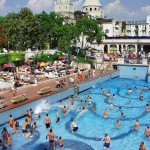 |
| Outdoor wave pool in summer |
 |
| Gellert Hotel |
I remember having come here in 2004, just before Hungary joined the European Union, and it was a little more austere. There were women only days and men only days, women only pools and men only pools, and these were all a little faded glamour. The massage and treatment cubicles are tasteful and private (not like the stainless steel tables laid out in rows in one big room like a synchronized surgical unit that I have the good fortune to deal with).
As elsewhere, you get your Dick Tracy wristband (here it worked seamlessly but it might just be because I know the drill now) and use either a locker or a tiny change cabin. Again, as for the others, the water contains The water contains calcium, magnesium, hydrocarbonate, alkalis, chloride, sulfate and fluoride and serves to treat degenerative joint illnesses, spine problems, chronic and sub-acute joint inflammations, vertebral disk problems, neuralgia, vasoconstriction and circulatory disturbances, asthmas and chronic bronchitis. It's like reading my autobiography of ailments!
The mosaic floors and walls of the main entrance, hallways and surrounding the pools, were made by the famous Zsolnay factory, which I must admit I had never heard of, but further research indicates that yes, indeedy, it is a very famous factory indeed. It started to produce stoneware and other ceramics in 1853, but the son of the founder took it to the world by exhibiting at many world, including Paris in 1878, where the company won a Grand Prix (and where the newly completed head of the Statue of Liberty was also exhibited). By 1914, Zsolnay was the largest company in the Austro-Hungarian Empire, although it was resigned to making insulators during the first world war, and after, during the Serbian occupation. The name changed along the way but changed back in 1982 when times started to get better. Still a vital concern, the company signed a huge contract with IKEA in 2008 to supply a whopping 5,000 tonnes of ceramics every year!
The Gellert baths are quite pricey, so it's good to have enough time to thoroughly enjoy them. And be honest. Can you look at these photos and not want to go there??
 |
| tile floor in the entrance hall |
 |
| entrance hall |
 |
| stained glass ceiling |
Friday, November 27, 2015
Thermal Bath 3: Lukács
I wanted to try the Lukács thermal bath because it is less well known by tourists, and is particularly popular with locals. It geothermal waters were used by the Knights of St. John, a Christian military order dedicated to caring for the sick, in the 12th Century. They were followed by the Knights Hospitallers, and the Rhodos and the Maltese Knights, who built baths next to their monasteries. The bath operated through the time of the Turks, in the 16th Century, but then the energy of the springs was used primarily to produce gunpowder and for grinding wheat.
The first spa hotel and wellness centre was built in the 1880’s, with a drinking cure hall (the "pump room") added in 1937, and a daytime hospital established in 1979 (the National Institute of Rheumatology and Physiotherapy) to treat locomotive diseases and act as a physiotherapy centre.

In 1999, the two open-air pools were modernised, and the so-called mud-pond, hardly used before, was replaced by what is endearing called the fancy pool, equipped with a river current, effervescence, neck shower, water beam back massage hidden in the seat banks, whirlpool, geysers, and effervescent bed. This is built completely surrounded by the walls of the hospital, serving as a liquid courtyard.

 The primary challenge of the Lukács is to actually find the entrance. It's not far from the Buda side of the Margit bridge, across a bit of parkland and into a maze of yellow buildings. the pump room is easy to find, and its strong suphur smell hits you as you go inside to ask the attendant where the heck the pools are. Following a winding path to the end, one enters a modest door and sees a payment kiosk.
That's the primary challenge, meaning that's just the first challenge.
Once inside I followed various hallways and followed helpful hand directions to find the locker room, but no locker worked with my plastic wrist band (identical to the one at Rudas except for its colours). Ah, I have a cabin, ok, where is that? More hallways, past a pool, past more pools, and then I am directed to cabin 6. Still, the band doesn't work. Guided to another section where there is another cabin 6. ??? Oh, yeah, it gets better. There are at least two more cabin 6s dotted throughout the complex. By this time I have used up 20 minutes of my two hour time and haven't got my skivvies off.
Finally, finally, I am in and changed and have a rented towel (an exorbitant amount that I am told will mostly be returned upon departure).
Tertiary challenge was finding out where to start. The two outdoor swimming pools looked lovely but are swimming pool temperature, and it is freezing outside and starting to get dark. But I do go into the Fancy Pool - I mean who can resist not going into the Fancy Pool? It's not hot but it is warm enough to enjoy spinning along the circular water river with other adults who are smiling like children. Trying to swim against the current is a good workout, as long as you are happy enough to not make any forward headway. There are shallow sunbathing shelves with jets under and over. But the best was just to sit neck deep and look around at the lovely golden building encircling the pool. On Saturday nights there are bath parties with DJ'd music and light shows which I can imagine get pretty raucous, and which has made it more well known and popular with those less medicinally affiliated.
Getting a little chilled, I moved into the older parts, the Turkish pools that had steps, or tiled seats in them and warmer temperatures. There is a modern cold plunge pool of course,
 and saunas and steam rooms as well, but the most intriguing pool to me was the Weight Bath, built for stretching the back and treating spinal injuries and "deformities". Much as I don't really consider my scoliosis a 'deformity' I suppose speaking strictly anatomically it is, so I was intrigued at the narrow deep pool with a sort of shoulder grip so that one can hang straight down in the water. If I used this every day I might get my lost 2 inches of height back. Alas, it is a one time affair so I channeled a bit of appreciation for it.

As one might expect from a hospital that provided prescriptions to the various treatments, it is accessible to the disabled. The list of therapies identified for its use are:
 The springs themselves are rich in (deep breath here) calcium hydrogencarbonate and calcium hydrogensulfite, magnesium hydrogencarbonate and magnesium hydrogensulfite, choride, sodium and fluoride ions.
I had such a good time that I did not get my towel deposit ba
ck as I was 15 minutes past my ticket time, which of course I blame wholeheartedly on the hunt for the correct and illusive cabin number 6.
The first spa hotel and wellness centre was built in the 1880’s, with a drinking cure hall (the "pump room") added in 1937, and a daytime hospital established in 1979 (the National Institute of Rheumatology and Physiotherapy) to treat locomotive diseases and act as a physiotherapy centre.

In 1999, the two open-air pools were modernised, and the so-called mud-pond, hardly used before, was replaced by what is endearing called the fancy pool, equipped with a river current, effervescence, neck shower, water beam back massage hidden in the seat banks, whirlpool, geysers, and effervescent bed. This is built completely surrounded by the walls of the hospital, serving as a liquid courtyard.
That's the primary challenge, meaning that's just the first challenge.
Once inside I followed various hallways and followed helpful hand directions to find the locker room, but no locker worked with my plastic wrist band (identical to the one at Rudas except for its colours). Ah, I have a cabin, ok, where is that? More hallways, past a pool, past more pools, and then I am directed to cabin 6. Still, the band doesn't work. Guided to another section where there is another cabin 6. ??? Oh, yeah, it gets better. There are at least two more cabin 6s dotted throughout the complex. By this time I have used up 20 minutes of my two hour time and haven't got my skivvies off.
Finally, finally, I am in and changed and have a rented towel (an exorbitant amount that I am told will mostly be returned upon departure).
Tertiary challenge was finding out where to start. The two outdoor swimming pools looked lovely but are swimming pool temperature, and it is freezing outside and starting to get dark. But I do go into the Fancy Pool - I mean who can resist not going into the Fancy Pool? It's not hot but it is warm enough to enjoy spinning along the circular water river with other adults who are smiling like children. Trying to swim against the current is a good workout, as long as you are happy enough to not make any forward headway. There are shallow sunbathing shelves with jets under and over. But the best was just to sit neck deep and look around at the lovely golden building encircling the pool. On Saturday nights there are bath parties with DJ'd music and light shows which I can imagine get pretty raucous, and which has made it more well known and popular with those less medicinally affiliated.
Getting a little chilled, I moved into the older parts, the Turkish pools that had steps, or tiled seats in them and warmer temperatures. There is a modern cold plunge pool of course,
As one might expect from a hospital that provided prescriptions to the various treatments, it is accessible to the disabled. The list of therapies identified for its use are:
- traumatic aftercare
- aftercare following bone or joint operation
- the inactive stages of chronic, inflammatory locomotor disorders (eg. rheumatoid arthritis, articular diseases, Bechterew-disease)
- chronic neuritis
- nervous pains
- the inactive stages of chronic degenerative bone and joint diseases
- osteoporosis (calcium deficiency of the bones)
- degenerative joint diseases
- spinal deformity
- discus hernia
- neuralgia
- post-accident rehabilitation

I had such a good time that I did not get my towel deposit ba
ck as I was 15 minutes past my ticket time, which of course I blame wholeheartedly on the hunt for the correct and illusive cabin number 6.
 |
| good clean fun |
Thursday, November 26, 2015
Thermal Bath 2: Széchenyi
The plan was to go to one of the few baths on the Pest side, and one of the largest in Europe, as well as one of the newest in Hungary, being "only" just over 100 years old, although it has been added to several times since it was built in 1913. It is situated in the expanse of City Park, which is able to contain its 18 pools and 10 saunas and steam rooms. Named after a politician, statesman, theorist and writer, who presumably bathed as well, Széchenyi baths are truly spectacular.
Or at least, I think they are. I don't know exactly because on my way towards City Park I stumbled upon a large Christmas market with wonderful crafts and foods, mulled wine and the best grog I've ever had (with freshly muddled ginger and a slice of lime). It was cold and the coin toss between warm lights and hot drinks won out over bathing in the outdoors.

Next time, Széchenyi, you are mine!

Or at least, I think they are. I don't know exactly because on my way towards City Park I stumbled upon a large Christmas market with wonderful crafts and foods, mulled wine and the best grog I've ever had (with freshly muddled ginger and a slice of lime). It was cold and the coin toss between warm lights and hot drinks won out over bathing in the outdoors.

Next time, Széchenyi, you are mine!

Wednesday, November 25, 2015
Thermal Bath 1: Rudas
Day 1 of 4: Rudas Thermal Bath
Under Gellert Hill lies the Rudas thermal bath, first built in 1550, during the time of the Turkish occupation. This old part has an octagonal pool under a traditional dome.

At the end of the 19th century, a therapeutic swimming facility and a sauna was added. There is also a newer 'wellness section', with a pool fed by the water spring Juventus, a cold water immersion pool, an outdoor rooftop pool and a hot water pool.
 |
| the spread of Rudas bath, with the rooftop pool on the left and the original Turkish pool roof on the right |
 |
| small rooftop pool under the dome |
Now let's get one thing straight. Neither I nor my spine do cold water plunge pools (i.e., anything under 20 degrees C) so just cross that off your list of expectations. I can be persuaded to sit in an outdoor pool, but not in the dark of a winter day on the roof of a riverside building.

First is negotiating the costs and mechanics of taking the waters. It's possible to rent a bath sheet, which is really a single bed sheet. One is required to wear a bathing cap, men too! and it's not a bad idea to have flip flops. When you pay, you receive a plastic wrist apparatus, which looks like a child's play watch with no water face. This is to be held next to an entrance gate, where a light turns from red to green to let you through. It also activates the lock on a locker in the co-ed change room, which has little closets for changing modestly.
 |
| the old changing cabins |
A delightful experience all in all, although the strangest thing happened once dressed. It must be the particular mix of minerals in the baths that caused it. My right big toe, which had been broken when I was about 12 years old, was painful right along the break line for quite a while afterwards. I wonder if others who have suffered breaks in places that are possible to heal properly have felt the same line of pain. I may have to investigate further.
Waterbabying in Buda
I almost got to waterbaby in Pest as well but got a bit sidetracked by a Christmas market and a big glass of mulled wine.
Yes, I have decided that waterbaby can be a verb.
I waterbaby
You waterbaby
He/She waterbabies
We waterbaby, etc.
Verbs generally denote action of course, and setting out to explore the therapeutic value of thermal baths in Hungary's largest city, in winter, requires effort being made: physically and intellectually if not linguistically.
As everyone's favourite information source, Wikipedia, indicates: "A thermal bath is a warm body of water. It is often referred to as a spa, which is traditionally used to mean a place where the water is believed to have special health-giving properties." The therapy part comes from spending time in thermal baths as part of one's regular medical and wellness practice, and doctors in Hungary often prescribe spa water treatments to their patients, young and old.
Budapest is not the only place in Hungary with thermal baths, but there are a lot of them dotted along the Danube dividing Buda and Pest. Most of these are along the Buda shore, which makes sense as the limestone rises up in hills and benchs, so that layers of hot mineral waters lie in layers of rock. The friends, Romans and countrymen settled in the area in part because of these hot springs, and there are still ruins from this period to be found here.
The new era was not so new to us, but some of the baths that were built during this time are incredibly still in use despite their centuries, when the Ottoman Empire stretched up this far north. Their 16th century oval roofs and octagonal pools are striking and recognizable to anyone who has spent time in Turkey. The next great era of thermal baths was the late 19th century, with grand palace-like halls over and around enormous pools, indoors and outdoors, for the hordes.
For me, it was an opportunity to: a) explore a key part of Hungary's cultural practice; b) get warm in a frosty cold Budapest in winter; and c) see whether or not there was anything in the claims of medicinal value placed on the waters for degenerative bone conditions and chronic joint inflammations, among other things. My curvy little spine was in for a treat!
4 days: 1 spa a day; among several to choose from.
Yes, I have decided that waterbaby can be a verb.
I waterbaby
You waterbaby
He/She waterbabies
We waterbaby, etc.
Verbs generally denote action of course, and setting out to explore the therapeutic value of thermal baths in Hungary's largest city, in winter, requires effort being made: physically and intellectually if not linguistically.
As everyone's favourite information source, Wikipedia, indicates: "A thermal bath is a warm body of water. It is often referred to as a spa, which is traditionally used to mean a place where the water is believed to have special health-giving properties." The therapy part comes from spending time in thermal baths as part of one's regular medical and wellness practice, and doctors in Hungary often prescribe spa water treatments to their patients, young and old.
Budapest is not the only place in Hungary with thermal baths, but there are a lot of them dotted along the Danube dividing Buda and Pest. Most of these are along the Buda shore, which makes sense as the limestone rises up in hills and benchs, so that layers of hot mineral waters lie in layers of rock. The friends, Romans and countrymen settled in the area in part because of these hot springs, and there are still ruins from this period to be found here.
The new era was not so new to us, but some of the baths that were built during this time are incredibly still in use despite their centuries, when the Ottoman Empire stretched up this far north. Their 16th century oval roofs and octagonal pools are striking and recognizable to anyone who has spent time in Turkey. The next great era of thermal baths was the late 19th century, with grand palace-like halls over and around enormous pools, indoors and outdoors, for the hordes.
For me, it was an opportunity to: a) explore a key part of Hungary's cultural practice; b) get warm in a frosty cold Budapest in winter; and c) see whether or not there was anything in the claims of medicinal value placed on the waters for degenerative bone conditions and chronic joint inflammations, among other things. My curvy little spine was in for a treat!
4 days: 1 spa a day; among several to choose from.
Subscribe to:
Posts (Atom)